Friday, 9 December 2011

The Magical Mystery Cruise - Haifa & The British Cemetery, Israel


We had been advised by our excursion team on board that it was not a good idea for ladies to go ashore on their own in Haifa.  I queried this as I could see no reason for such extreme precautions in what I considered would be a modern western city.   As it turned out I DID go ashore alone and actually felt ten times safer than I do every day on the streets of Croydon !

I wanted to try to find the British cemetery which I understood was quite near the centre of town.  A guy at the local tourist information desk could not find it marked on the map (can they ever !) but told me roughly where it was and what buses I could catch.  From the looks of things it seemed to be just up the road so I said I would walk.  I was advised in rather guarded terms that it was in the Arab quarter and that the bus would be better.  I walked !!

As it happened it was just fifteen minutes walk away and none of the locals gave me a second glance.  The cemetery seemed to consist of three sections – The Templar Cemetery which was that of the original German settlers dating back to 1869; the British Commonwealth War Graves Cemetery with graves from both the First and Second World Wars; and a final section which housed two large World War Monuments. All of these sections were immaculataly maintained.  The Templar Cemetery with lush vegetation and the other two sections with carefully maintained lawn.

The caretaker of the Templar Cemetery was very helpful and friendly and insisted that I sign his Visitor’s Book.  I then spent an enjoyable hour photographing the British war grave headstones.  By this time it was getting rather hot and I knew that I should head back to the ship for a break.  On the way out I noticed a rather battered looking metal gate at the rear of the cemetery.  I ventured up, peered inside and saw what appeared to be a fourth section of the cemetery.  This area had the appearance of not being cared for at all.  Granite chips took the place of lawn and there was no lush vegetation to soften the harshness of the sun.  Many of the crosses from the headstones were broken and lay on the ground.  I started to look at the inscriptions and to my surprise found that this was actually the old British Cemetery proper.  Here lay the civil servants, the railway engineers, the wives and children and – most impotantly of all – those members of the British Palestine Police who had given their lives during the 1930s.  I forgot that the sun was beating down on me (and that I desperately needed the loo!) and set about photographing these headstones.  The light was far too bright for the camera to be able to pick up some of the inscriptions but I did what I could.

On the way back to the ship I was overcome by sadness at the sight of this cemetery.  These poor souls were hidden away at the back as if their presence was an embarrassment.  I promised myself that after lunch and a short rest I would return in the afternoon.

At 2pm I returned and noticed that the sun was now casting shadows on many of the headstones and that the shadow made the inscriptions stand out from the bright stone.  I photographed all the headstones again in the hope of getting some better pictures.  Every five minutes or so I heard the monotonous clanging of a bell and realised that there must be a level crossing nearby and the bell was to warn of an approaching train.  A passenger train would pass and silence would reign for 3-4 minutes until the bell clanged again.  This time it would be a freight train and then silence for another few minutes. I ventured to the far side of the cemetery and noticed that the embankment was slowly crumbling away.  In a few years the graves on this side of the cemetery could find themselves rolling down the embankment onto the track.  This was definitely a folorn spot and I could find nothing good to say about it.  I laid my hand on the headstones and told them they had not been forgotten but in my heart of hearts I knew this was not the case. When I get home I will research as many of them as possible and do what I can to keep their memories alive.

The Magical Mystery Cruise - Massada & The Dead Sea, Israel


This was going to be an extremely long day as the drive to Massada was to take 3.5 hours from the northern port of Haifa.  I was up at 5.30am and off the ship by 7.30.  Today we had a wonderful Israeli guide who was friendly, helpful and informative.  What a change from yesterday.  We took a south easterly route to start with through the Yizreel Valley and then on past Mount Gilboa.  I was amazed to see how the efficient Israeli irrigation system has turned barren countryside into fertile growing areas – crops and fruit were in abundance.  Then we headed south through the Jordan valley and the countryside took on the appearance that I had been expecting – dry desert with rocky hills rising steeply from the roadside.  There in the distance was a small town nestling on the plain and this turned out to be Jericho.  A few miles further on we made a stop at Qumran which is the area where the Dead Sea scrolls were discovered and there at the foot of the valley was the Dead Sea itself.  The lowest sea on earth, so full of minerals that it is impossible to sink. 

Our next stop was at Herod’s Palace in Massada – way up on the top of the mountain.  A cable car ride was necessary in order to get to the top but then we had an incredible one and half hour tour of the site.  This was absolutely “out of this world” and thoroughly enjoyable.

After that it was off to lunch in a resort hotel on the banks of the Dead Sea and those who wanted to could try the experience of floating in the mineral laden waters.  I spent my time looking for photo opportunities but I did have the most wonderful buffet lunch – with wine.

By the time we left the shores of the Dead Sea at 5pm it was pitch dark and the drive back to Haifa seemed very long and tedious.  But what a day, what sights, what experiences.

Magical Mystery Cruise - Kyrenia, Northern Cyprus

During all those years when I was holidaying in Cyprus never once did I visit the place that I most wanted to go to – Kyrenia.   In those days it was not possible to cross the border in Nicosia and travel from Greek Cyprus into Turkish Cyprus.  Now the wall has opened up and at last I was able to make the trip.

I had hoped to bring news of a wonderful hour and half spent wandering the streets of this interesting town and of finding the old British cemetery which is marked on maps as “Ingliz Mezarligi”.  The cemetery is a fifteen minute walk from the central square so an hour at leisure would have been heaps for me to visit.  Alas, on this occasion, my plans were not achievable due mainly to the complete and utter disorganisation of the tour.  As we drove into Kyrenia after leaving the ruins of Bela Pais (which had included a 25 minute queue to use the one ladies loo !) I spotted the cemetery on the outskirts of town.  My excitement mounted and I was ready to jump off and speed away as soon as the coach came to a halt in the square.  However, as the guide showed us our meeting point I was greeted with the news that we had only 30 minutes at leisure !!!!  This was absolutely ridiculous and I was more than disappointed as I knew that there was no way for me to get to the cemetery.

Everything about the day was a disaster.  The female Greek Cypriot guide was abrupt and unhelpful in the extreme.  Time was wasted at both Bela Pais and at the restaurant.  Lunch itself was a complete shambles.  No proper arrangements were made for comfort stops during 9 hour day.  In fact so many complaints were made about the excursion that P & O had to resort to refunding us 33% of the cost – but the refund in no way made up for the fact that I had been able to see so very little of the town I had gone to see !!

Lets pass over this and move on to Israel.

Thursday, 1 December 2011

The Magical Mystery Cruise - Kusadasi (Bird Island), Turkey


This was the second of our replacement ports of call and not having been able to do any research I had very little idea of what to expect.  I had three options 1) stay on board the ship all day – 2) take a very expensive organised excursion – 3) wander around the local area and try to find something of interest.  Option 1 was not a contender as I could never visit a port and not get off to see something of the area.  As there were some short tours on offer I decided to combine both the remaining options i.e. a tour in the morning and a short wander around town in the afternoon.

The tour I opted for was called The Glory of Ephesus.  What or where is Ephesus??  The city of Ephesus dates back to pre-Ionian times when the Carians and Lelegians lived in a wide plain near the Temple of Artemis, one of the seven wonders of the Ancient World.  St. John is said to have written his Gospel here and it is also meant to have been the last home of the Virgin Mary.  The ruins of this very ancient city are only ten miles away which is why Kusadasi has become known as The Gateway to Ephesus.

Our first stop was at the Basilica of St. John where I was greeted with the sight of tall pillars rising into the sky.  Huge chunks of highly carved marble dotted the ground lying where they had fallen from pillars centuries ago.  Here and there were large round earthenware water pots whose deep orange hue contrasted vividly with the white of the marble.  The guide spent 45 minutes explaining the history of the site and then allowed 10 minutes for photo taking.  Having been on a number of excursions in the past I know how frustrating this can be so right from the outset I set off on my own snapping picture after picture so that I have my own memories of the place.  From the ruined walls I looked down to see one single pillar rising from the plain below.  Apparently this is all that survives from the once impressive Temple of Artemis.

Then it was onto Ephesus proper and what sights were in store for me there.  The Temple of Hadrian; The Library of Celsus; The Marble Street.  The tour took us through the main thoroughfare from the high hillside entrance down to the plain.  If I had strayed too far from the guide there was every chance of getting lost here but whenever possible I struck out on my own for a few minutes.  It was during one of these “stolen” moments that I came across an American photographer.  She had two cameras strung around her neck the most impressive of which would not have looked out of place in a museum.  I asked her about it and she told me that it had belonged to her grandfather and that it still worked as good today as it had 55 years ago when he had purchased it.  In fact it took much better pictures than todays digital varieties.  She told me that she was a freelance photographer from a little town called York – New York (!!).  Apparently she was as frustrated as I was with having to stay with a guide but she had the flexibility of being able to return the next day when she hoped to visit much earlier in the morning when the light would be better for her photographs.  I bumped into her again on a couple of other occasions during the morning when both of us were again “stealing” time from the guides. At one point we both discovered one of the city’s cats who was posing unashamedly on a ruined pillar. It was lovely to see a livng animal amongst all the ruins but I bet her photograph will make mine look amateurish.  Who knows, perhaps one day I may come across the one she took in National Geographic and be able to compare them!

Well, the excursion may have been expensive but it certainly gave me the chance to take some wonderful photos – and I loved meeting the lady from the little town called York.

After lunch I took myself off into the local town of Kusadasi and walked around the harbour and out to the fortified island which was reached by a causeway.  This again proved a good vantage point for taking photos and yet again I came across cats who were desperate to get into my pictures.  I think I may have to rename this blog The Cruise for Cats. 

I have no regrets at visiting Kusadasi instead of Port Said.  It was wonderful to have the opportunity of seeing the ruins of Ephesus but I don’t think there is anything in Kusadasi itself which would ever draw me back.

The Magical Mystery Cruise - Medieval Malta


When I heard that we were to call at Malta I knew that there was just one place that I had to try to visit – the grave of Detective Sergeant Harry Battley who was killed in an air crash off Lampedusa in 1945.  I have been researching Harry for years so to come to Malta and not find him would be so sad.  The small cemetery was at Mtarfa but where was Mtarfa and would it be possible for me to find my way there and back to the ship in the few hours that we were to be in port at Valletta?  The easy option would be to hire a taxi for the day but that always proves highly expensive – and why take the easy option when there are probably more adventurous means !!

As always I was one of the first down the gangplank and headed off for the 20 minute UPhill climb into town.  I noticed the buildings were ancient and beautiful.  Pinkish, yellowish blocks towered up four or five stories above my head and all were dotted with balconies of various design and colour.  The streets were narrow and almost deserted as the city had not yet awoken.  I spotted a small grating at street level out of which poked the cheeky the faces of several kittens who had taken up residence in the vaults of the church.

After several false turns I managed to find the Tourist Information Office and enquired about the cemetery at Mtarfa.  Oh yes, there was a British Cemetery there but none of the tourist maps showed where exactly it was and none of the staff were able to point out its location on the map.  I was told that I could catch the No. 51 bus to Mtarfa and that the driver would be able to point out the cemetery when I got there.  For someone who always plans her journeys to the nth. degree this was not very reassuring!!  So there I was in a strange country heading for the bus station to get on a bus that would take me to a small village miles from the coast.  I must have been mad but when a grave calls there is nothing for it but to go !  I found that I needed to buy a one day travel pass for the princely sum of 2.60 Euros from the ticket office.  Then there was a 25 minute wait for the No 51 which I noticed went to Mtarfa via the ancient cities of Mdina and Rabat.  When the bus arrived I was almost carried on amidst the hustling, bustling locals.  The ladies were in fine voice and shouted and laughed about everything around them.  Off we set in the rush hour traffic heading out of town in a westerly direction.  I followed our course as best I could on a very basic tourist map and after 40 minutes found we were entering Rabat.  The next village - the last on the route - was Mtarfa.  I enquired of the bus driver the way to the British cemetery but he had no idea !  Great – now here I was in the interior of the country with no idea which direction to make for. 

Sunday, 27 November 2011

The Magical Mystery Cruise - Cadiz , The Cup of Silver


I was up on deck at 6.45am to watch our arrival into Cadiz.  It was quite chilly but I nestled snugly inside my padded waistcoat with hood up to protect my ears from the strong winds.  The Cathedral and several churches were illuminated and stood out brilliantly against the bluish purple blackdrop which was the dawn sky.  As the sun rose over the horizon so my anticipation mounted.  The city looked every bit as I had imagined it – a jumble of low square white washed houses interspersed with tall watch towers of varying designs.  I could sense the Moorish feel even at a distance.

As soon as we berthed I was off down the gangplank to explore. I hoped to find the Tavira Tower which I understood was one of the few watchtowers that was open to the public and which apparently offered outstanding views of the city.  I knew roughly which direction to head in but I don’t think a map has been produced which can really show all the twisty turny narrow alleyways which are the main thoroughfares of Cadiz.  I marvelled at how cars and taxis could negotiate these tiny cobbled streets without knocking down the pedestrians but “shank’s pony” and motors all seemed to live in harmony.

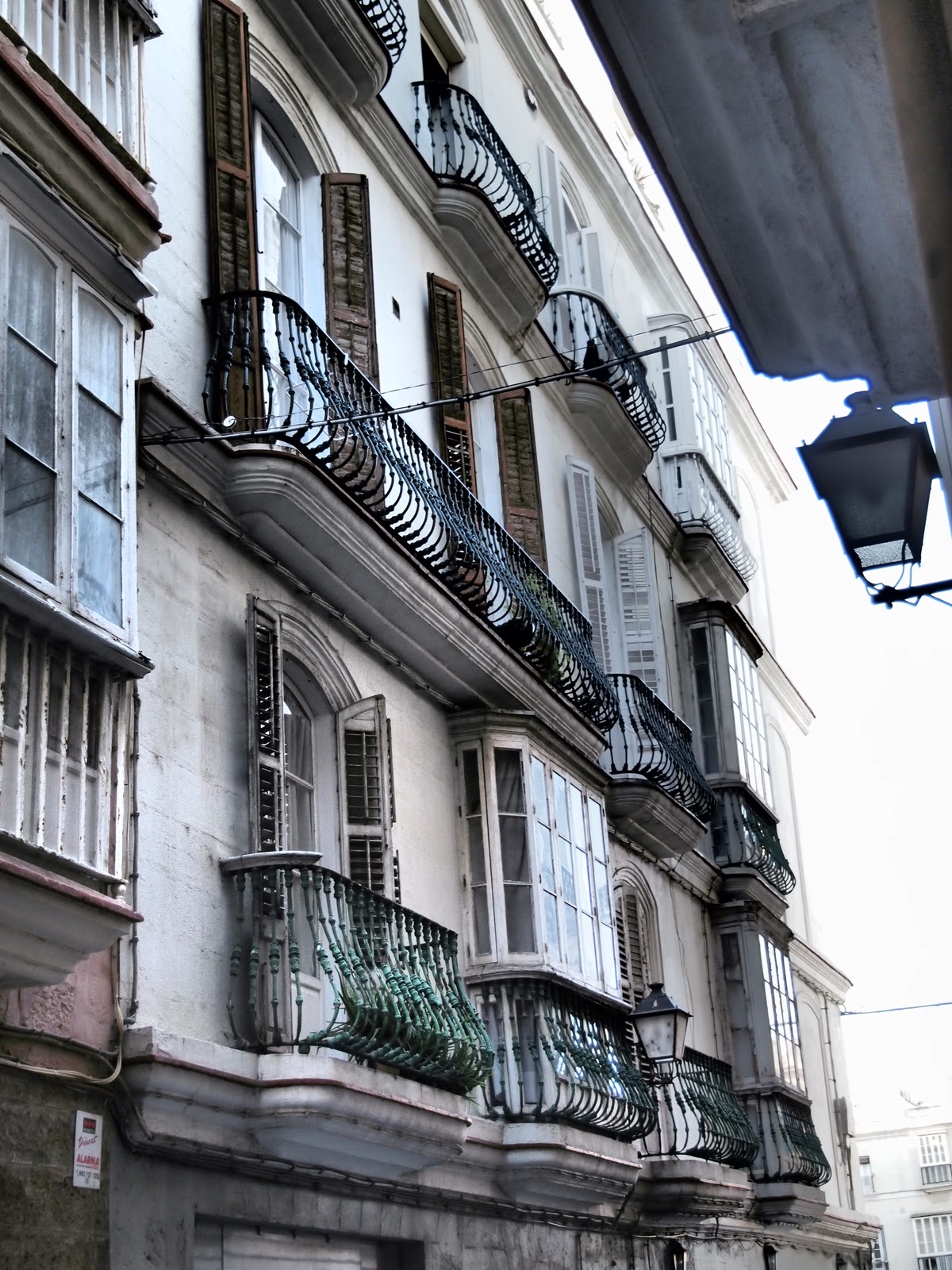
There was an endless array of sights to tantalise and my camera was constantly busy snapping pictures here, there and everywhere.  The balconies were particulary fascinating for the bottom area curved out in intricate design.  I was told that in the 18th. Century it was the fashion for ladies to wear skirts which had large rigid hoops at the hem and the railings had been designed to accommodate these.  On normal balconies the hoop would have hit the railing and risen into the air revealing a little too much of the lady’s underwear !!!!!

Miracously I found the Tavira Tower and had a ten minute wait before it opened at 10am.  In 1778 this tower had been appointed the official watchtower for the town because at that time it was the highest lookout point in the area. In general the towers were used by traders to watch for their ships returning loaded down with goods from the East and West Indies.  The door was opened punctually at 10am and I was the first customer of the day.  After paying the 5 Euro entrance fee I started the climb to the top.  Up and up and up I went with the stairs getting narrower the higher I climbed.  Eventually I reached the top parapet and ventured out to be greeted with the spectacular sight of the city’s rooftops spread out like a patchwork quilt before my eyes.  WOW.  My camera worked overtime but I cursed myself for not putting the telephoto lens in my bag before I left the cabin.  Never mind, there was more than enough to excite my imagination.  A little while later I heard some puffing and groaning and all of a sudden a man appeared through the doorway.  He told me there were two ladies following him but that they would take some time to get to the top.  Apparently these three were from the other cruise ship in port that day – The Independence of the Seas.  Cadiz was their last port of call before they headed back across the Bay of Biscay to Southampton.  Eventually with much huffing and puffing the two ladies made it to the top.  That was my cue to head down to the Camera Obscura which was one floor below.  The first show of the day was due to start in just a few minutes.  The Camera Obscura projects a movng image of the surrounding town onto a bowl shaped screen which sits in the centre of a darkened room.  The other three joined me in the room and the projectionist started the show.  It was fascinating but the part I enjoyed most of all was when the projectionist put a piece of cardboard down onto the screen and then “lifted” people up from the streets.  Of course, they would have no knowledge that they were being played with in this way.  It was rather an eerie thought to think that later in the day I might be walking the streets of Cadiz and that I might be one of the subjects being “lifted” off the screen for others amusement !!  The show came to an end and then it was off down the stairs and out into that maze of alleyways again.

I made my way back to the ship to get my telephoto lens – better late than never !!  Then on my second trip out I made for the Cathedral.  I had learned that one of the bell towers is also open to the public and that this is even higher than the Tavira Tower.  It was now mid-day and many of my co-passengers on the Oceana were now also out and about.  As I passed through the main square of town I noticed that some had found seats and had their noses firmly rooted in books.  They were all of five minutes walk from the ship and as ever I was amazed at the lack of interest that some people show in their surroundings.  Why on earth come on a cruise, visiting wonderful locations, if you are not going to show any interest in where you are?  How can they not want to explore?  Beats me !!

Soon I stood in front of the Cathedral with its two imposing bell towers.  At the base of one was a small wooden door which stood ajar.  I entered and in the dark interior found a small pay booth where I purchased my ticket for a fee of 4 Euros.  Then I started the climb but I was surprised to find that there were no steps.  The pathway up was a steep slope which went round and round and round and round.  This climb certainly got to me and it was not long before I was really huffing and puffing.  I told myself that if I could get to the top of Big Ben then I could make this.  I did – but only just !

Again at the top I was greeted with the spectacular sight of the city spread out before me.  But this time I was surrounded by the cathedral’s bells which suddenly started to chime.  As I now had my telephoto lens I was able to zoom in on some of the more interesting buildings – and to my delight I had a wonderful view of the Tavira Tower where I had been just a few hours earlier.  The climb may have puffed me but it was certainly worth the effort.

The rest of the afternoon was spent meandering through the narrow streets and soaking up the atmosphere of this Moorish town.  I noticed a street vendor selling salted nuts but he didn’t seem to be getting much custom as everyone was making for tavernas and coffee shops.  I went up and bought 1 Euro’s worth of nuts.  He was delighted and filled the paper cone to overflowing for me.  I am not certain what sort of nuts they were but they were delicious.

I was absolutely exhausted by the time I returned to Oceana in the afternoon.  I found just enough energy to go to dinner and then went to listen to the classical recital before collapsing into bed at 8.30pm.  I slept like a log.

The Magical Mystery Cruise - Oceana


Why have I called this the Magical Mystery Cruise?  Quite simply because at the time of embarkation I was not at all certain of where we were going to end up.  Months ago the second port of call, Tripoli in Libya, had been replaced by Alexandria in Egypt.  This was due to the troubles that were being experienced in Libya at that time.  Two weeks before departure I was informed that the ship was no longer going to be able to call at Ashdod in Israel – this time due to the troubled situation in Syria.  Then, three days before departure, I turned on the news to be greeted with the sight of riots in Alexandria and Cairo.  I tried to tell myself that this was just going to be a “storm in a teacup” but as the hours wore on it was apparent that the situation was getting worse and worse.  I tried to imagine myself viewing those magical pyramids with the sound of tear gas being fired in the background.  I tried to imagine myself wandering through the streets of Alexandria in search of the Chatby Cemeteries whilst rioters sped past me.  Neither were very happy nor very practical thoughts.  P & O were obviously going to have to replace the stops at both Alexandria and Port Said with other ports of call – but where ?  As I embarked I – and all the other passengers – had no idea at all what the final itinerary was going to be !

This is my first time on Oceana and she is certainly a lovely ship – about the same size as Arcadia but with a beautiful atrium rising up in the centre from Deck 5 to Deck 8.  The buffet style restaurant is The Plaza on Deck 14 and this is situated at the bow with the most incredible views out across the sea.  As always my very favourite part of the ship is The Prom Deck.  It is here, early in the morning and late at night, that I am able to get my exercise.  3.2 laps of the prom equate to one mile and on sea days I like to do two miles morning and evening.  When it is deserted it is the one place on board that evokes the feel of the old P & O liners which “back in the day” plied the route from UK to Hong Kong. If I squint my eyes up I can imagine those passengers from the early 1900s boarding with their leather suitcases and trunks adorned with hotel labels from exotic lands.  The ladies in their wonderful hats and fur wraps, the gentlemen in their tweeds.  Their feet would have stood on deck boards just the same as this.  They would have looked out at the vast ocean from the Prom Deck just as I do.  Here are the markings for Deck Quoits & Shuffleboard – just as they have always appeared. 

In 1909 Ellen Mary Hayes Peck wrote in her travel diary:   

Two hundred and fifty more passengers were added to the steamer list at Marseilles and henceforth the vessel was to be taxed to her utmost capacity.  Most of the passengers ere en route for a five weeks voyage to Australia, many of them were friends, and a general spirit of jollity prevailed, the decks presenting the appearance of a seaside veranda, with their tables, lounging-chairs, work baskets, and toys.  A sports committee was at once formed and games of all kinds were played (always for prizes) while a concert, dances and bridge enlivened the evening hours.

After a rather boring few hours traversing the Suez Canal she continued:

But if Nature was dull and lifeless, there was no lack of jollity on board the steamer; for the passengers were mostly English, and there were constant games or other devices for “killing time”, in which the English as a nation are so proficient.

It is just the same on board in the 21st. century.  During the day deck games abound, lecturers expound on a variety of subjects, art, craft & dancing classes are held and the mysteries of digital cameras are explained.  Of course many just want to do nothing and that is also very exceptable.  In the evening there are classical concerts, pop concerts and musical shows – and of course there is still a Bridge Room for those who wish to play. 

During our first night at sea we hit rough weather as we approached the Bay of Biscay and half the passengers were confined to their cabins for that first full day.  I donned my wrist bands designed to prevent sea sickness and was able to explore the ship at leisure.

It was on our second day at sea that the Captain made the announcement that we had all been expecting – on the advice of the Foreign Office our calls to both Alexandria and Port Said had been cancelled.  I waited in anticipation to hear what the replacement ports would be.  I was not disappointed to hear that we would instead be visiting Valletta in Malta and Kusadasi in Turkey.  But before these intriguing places comes Cadiz, the oldest continuously inhabited town in the Western World with a history dating back 3000 years.  Watch this space !